

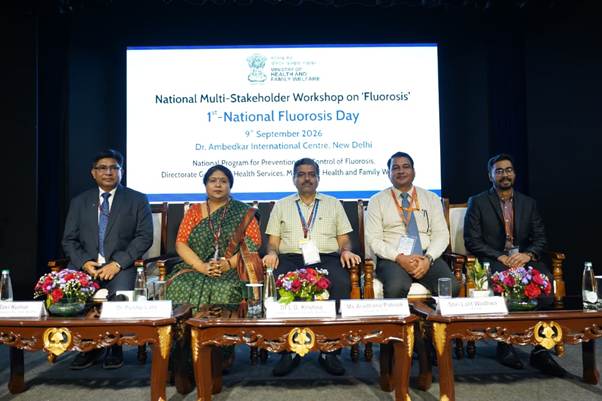
NEW DELHI: The Union Health Ministry organised a national multi-stakeholder workshop on fluorosis on Thursday to strengthen efforts for prevention, early detection and management of the disease across the country.
The workshop was organised by the Directorate General of Health Services on the occasion of National Fluorosis Day under the National Programme for Prevention and Control of Fluorosis.
Representatives from several institutions and government departments took part in the programme, including the Ministry of Jal Shakti, Indian Council of Agricultural Research, Indian Council of Medical Research, AIIMS and the National Dental Commission. State-level nodal officers and programme consultants also participated.
The discussions focused on improving the implementation of the national programme and expanding its reach. Participants also discussed the importance of research, innovation, surveillance and early diagnosis in addressing fluorosis.
Fluorosis is caused by prolonged exposure to excessive levels of fluoride, particularly through drinking water. It can affect teeth and bones, with prolonged exposure potentially leading to skeletal problems.
Officials highlighted the importance of cooperation between the health, water and sanitation sectors because prevention depends significantly on reducing exposure to excessive fluoride.
The workshop also provided an opportunity for states and other stakeholders to share field-level experiences and discuss approaches that could improve prevention and treatment.
The National Programme for Prevention and Control of Fluorosis aims to strengthen surveillance, health education, capacity building, early diagnosis and management of cases.
The health ministry said a coordinated approach involving different sectors would be important for reducing the impact of fluorosis and improving access to appropriate care.
The workshop is expected to support efforts to strengthen the programme and improve awareness and early intervention in areas affected by excessive fluoride exposure.

Comment here