

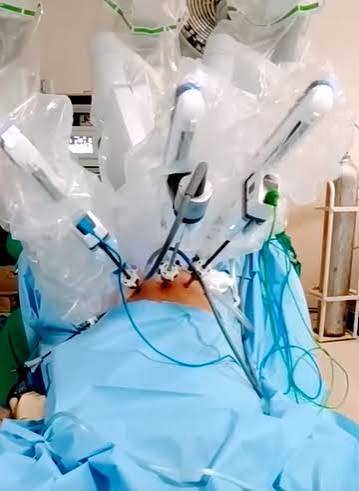
A surgeon based in Delhi has performed a robotic kidney cancer operation on a patient in Puttaparthi, Andhra Pradesh, using an indigenous telesurgery system. The procedure demonstrates how advanced surgical technology could help connect specialist doctors with patients in locations where access to complex medical care may be limited.
Dr Sudhir Rawal, Chief of Genito-Uro Oncology at Rajiv Gandhi Cancer Institute and Research Centre (RGCIRC), Delhi, remotely controlled the SSI Mantra surgical robotic system during the operation.
The procedure was a robotic partial nephrectomy, in which the cancer-affected portion of the kidney is removed while preserving as much healthy kidney tissue as possible. The patient remained at a hospital in Puttaparthi, where a local clinical team provided support throughout the surgery.
The operation was conducted as part of the Urological Society of India’s USI CARES initiative, which brings urologists together to provide surgical services and share expertise with younger doctors.
Telesurgery allows a surgeon to control robotic instruments from a different location. Commands are transmitted to the robotic system at the patient’s hospital, while video technology provides the surgeon with a view of the operating area.
The approach could help reduce the need for patients to travel long distances to access specialist surgeons. Travel, accommodation and time away from family can add to the burden of treatment, particularly for patients requiring complex cancer procedures.
However, remote surgery depends on reliable connectivity, low communication delays, trained medical teams and emergency arrangements at the patient’s location. The presence of an experienced local team remains essential.
RGCIRC has previously been involved in evaluating the SSI Mantra system, including telesurgery trials conducted in 2024.
The latest procedure adds to India’s experience with domestically developed surgical robotics. Wider adoption will require continued clinical evaluation, appropriate infrastructure and strict patient-safety protocols.

Comment here